
New: booking links. Let people book you in their own time zone.
Current Local Time in 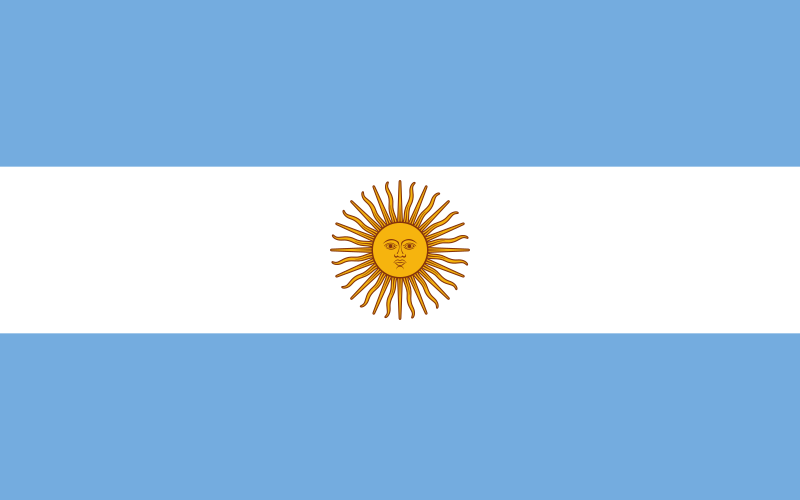 Argentina
Find best meeting timeBuenos Aires is already loaded in the meeting planner.
12hr|24hr

12:57:35am
Friday, October 23, 2026
Buenos Aires • America/Argentina/Buenos_Aires
Location
Interactive map loads after hydration. Capital coordinates: -34.61°N, -58.38°E.
Compare Times Live
The interactive time comparison grid loads in the live app. After the page hydrates you can add cities, drag rows, and share custom meeting windows.
HOME OF TANGO DANCEWORLD'S LONGEST COASTLINEPATAGONIA'S GLACIER REGIONFAMOUS FOR MALBEC WINEIGUAZÚ FALLS: NATURAL WONDERDULCE DE LECHE DELICACYGAUCHO CULTURE AND TRADITIONSPERITO MORENO GLACIERBIRTHPLACE OF CHE GUEVARAPAMPAS: VAST GRASSLANDSWORLD'S LARGEST MEAT CONSUMERSBUENOS AIRES' EUROPEAN INFLUENCEMALVINAS WAR HISTORYCARNIVAL CELEBRATIONS IN CORRIENTESUNIQUE SPANISH DIALECT: RIOPLATENSEHOME OF TANGO DANCEWORLD'S LONGEST COASTLINEPATAGONIA'S GLACIER REGIONFAMOUS FOR MALBEC WINEIGUAZÚ FALLS: NATURAL WONDERDULCE DE LECHE DELICACYGAUCHO CULTURE AND TRADITIONSPERITO MORENO GLACIERBIRTHPLACE OF CHE GUEVARAPAMPAS: VAST GRASSLANDSWORLD'S LARGEST MEAT CONSUMERSBUENOS AIRES' EUROPEAN INFLUENCEMALVINAS WAR HISTORYCARNIVAL CELEBRATIONS IN CORRIENTESUNIQUE SPANISH DIALECT: RIOPLATENSEHOME OF TANGO DANCEWORLD'S LONGEST COASTLINEPATAGONIA'S GLACIER REGIONFAMOUS FOR MALBEC WINEIGUAZÚ FALLS: NATURAL WONDERDULCE DE LECHE DELICACYGAUCHO CULTURE AND TRADITIONSPERITO MORENO GLACIERBIRTHPLACE OF CHE GUEVARAPAMPAS: VAST GRASSLANDSWORLD'S LARGEST MEAT CONSUMERSBUENOS AIRES' EUROPEAN INFLUENCEMALVINAS WAR HISTORYCARNIVAL CELEBRATIONS IN CORRIENTESUNIQUE SPANISH DIALECT: RIOPLATENSE
Country Information
Capital
Buenos AiresPopulation
17,156,208
Area
2,780,400 km²
Largest City
Buenos AiresDaylight Saving Time (DST)
Not Observed
ISO Code
AR / ARG
Time Zones
11 zone
Languages
Spanish
Currency
Argentine Peso ($) - $100
Coordinates
Decimal:-34.6131, -58.3772
DMS:34°36′47″S, 58°22′38″W
Elevation
Highest:6,962 m
Lowest:-105 m
Average:3,429 m
International Dialing Code
+54
Time Zones
• America/Argentina/Buenos_Aires| GMT-3 (UTC-3)
• America/Argentina/Catamarca| GMT-3 (UTC-3)
• America/Argentina/Cordoba| GMT-3 (UTC-3)
• America/Argentina/Jujuy| GMT-3 (UTC-3)
• America/Argentina/La_Rioja| GMT-3 (UTC-3)
• America/Argentina/Mendoza| GMT-3 (UTC-3)
• America/Argentina/Rio_Gallegos| GMT-3 (UTC-3)
• America/Argentina/Salta| GMT-3 (UTC-3)
• America/Argentina/San_Juan| GMT-3 (UTC-3)
• America/Argentina/San_Luis| GMT-3 (UTC-3)
• America/Argentina/Tucuman| GMT-3 (UTC-3)
Geographic Extremes
About Argentina
•Argentina is known for its rich cultural heritage, which is influenced by a blend of indigenous, Spanish, and Italian traditions.
•The tango, a passionate dance and music genre, originated in the working-class neighborhoods of Buenos Aires in the late 19th century.
•Argentina is home to the Andes mountain range, which includes Aconcagua, the highest peak in South America.
•The country is famous for its beef, which is considered some of the best in the world, leading to a strong barbecue culture known as asado.
•The Argentine flag features a light blue and white color scheme, with a sun emblem that symbolizes the Inca sun god Inti.
•The country has a diverse landscape that includes the Iguazu Falls, one of the largest and most stunning waterfall systems in the world.
•In the early 20th century, Argentina experienced significant European immigration, particularly from Italy and Spain, which has shaped its cultural identity.
•Spanish is the official language of Argentina, and it is spoken with a distinct accent known as Rioplatense, particularly in Buenos Aires.
•Argentina has a strong literary tradition, with renowned writers such as Jorge Luis Borges and Julio Cortázar making significant contributions to world literature.
•The economic history of Argentina includes periods of significant growth and crisis, notably the economic collapse in 2001, which led to widespread social and political changes.
•The country celebrates a variety of traditional festivals, such as Carnival and the Day of the Tradition, which honor its cultural heritage.
•Argentina is a leading producer of wine, particularly Malbec, and the Mendoza region is famous for its vineyards and wine tours.
•The Falkland Islands, known as Islas Malvinas in Argentina, have been a point of contention between Argentina and the United Kingdom since the 19th century.
•Argentine soccer is a major part of the national identity, with the national team having won multiple FIFA World Cup titles, including in 1978 and 1986.
Cities in Argentina
Showing 10 cities (top 50 by population + business hubs). Click any city to view detailed time information.
Cities by Population
Popular Cities in Argentina
Related Pages
findtime.io
Popular Cities
v4.5-1060-gae3c34c65-6429-ae3c34c
