
findtime.io
3:42:47pm
Total Solar Eclipse· 22d 19h 2m 13s

🌅The sun will rise at 5:16 AM
🌇The sun will set at 9:03 PM
☀️Sun will be up for 15h 47m today
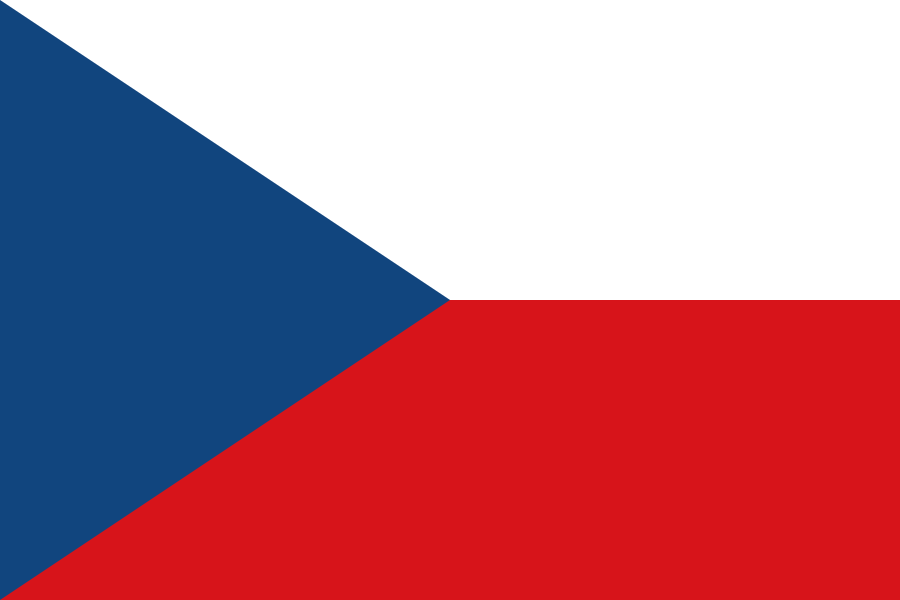
12hr|24hr
12:42:47am
Tuesday, July 21, 2026
Prague • Europe/Prague
Location
Interactive map loads after hydration. Capital coordinates: 50.09°N, 14.42°E.
Compare Times Live
The interactive time comparison grid loads in the live app. After the page hydrates you can add cities, drag rows, and share custom meeting windows.
HOME OF THE OLDEST UNIVERSITY IN CENTRAL EUROPEBIRTHPLACE OF PILSNER BEERUNESCO-LISTED CZECH CASTLESDYNAMIC TRADITION OF MARIONETTE THEATERCZECH GLASSMAKING TRADITIONHAVEL'S INFLUENCE ON DEMOCRACYBIRTHPLACE OF HEDGEHOG IN THE FOGCZECH LANGUAGE WITH UNIQUE ALPHABETVLTAVA RIVER RUNS THROUGH PRAGUETRADITIONAL EASTER WHIPPING CUSTOMCZECH KUBISM IN ARCHITECTUREBIRTHPLACE OF ALOIS JIRÁSEKCZECH REPUBLIC'S RICH FOLKLORE TRADITIONSHOME OF THE OLDEST UNIVERSITY IN CENTRAL EUROPEBIRTHPLACE OF PILSNER BEERUNESCO-LISTED CZECH CASTLESDYNAMIC TRADITION OF MARIONETTE THEATERCZECH GLASSMAKING TRADITIONHAVEL'S INFLUENCE ON DEMOCRACYBIRTHPLACE OF HEDGEHOG IN THE FOGCZECH LANGUAGE WITH UNIQUE ALPHABETVLTAVA RIVER RUNS THROUGH PRAGUETRADITIONAL EASTER WHIPPING CUSTOMCZECH KUBISM IN ARCHITECTUREBIRTHPLACE OF ALOIS JIRÁSEKCZECH REPUBLIC'S RICH FOLKLORE TRADITIONSHOME OF THE OLDEST UNIVERSITY IN CENTRAL EUROPEBIRTHPLACE OF PILSNER BEERUNESCO-LISTED CZECH CASTLESDYNAMIC TRADITION OF MARIONETTE THEATERCZECH GLASSMAKING TRADITIONHAVEL'S INFLUENCE ON DEMOCRACYBIRTHPLACE OF HEDGEHOG IN THE FOGCZECH LANGUAGE WITH UNIQUE ALPHABETVLTAVA RIVER RUNS THROUGH PRAGUETRADITIONAL EASTER WHIPPING CUSTOMCZECH KUBISM IN ARCHITECTUREBIRTHPLACE OF ALOIS JIRÁSEKCZECH REPUBLIC'S RICH FOLKLORE TRADITIONS
Country Information
Capital
PraguePopulation
3,093,590
Area
78,867 km²
Largest City
PragueDaylight Saving Time (DST)
Not Observed
ISO Code
CZ / CZE
Time Zones
1 zone
Languages
Czech
Currency
Czech Koruna (Kč) - Kč100
Coordinates
Decimal:50.0880, 14.4208
DMS:50°05′17″N, 14°25′15″E
Elevation
Highest:1,603 m
Lowest:115 m
Average:859 m
International Dialing Code
+420
Time Zones
• Europe/Prague| CEST (UTC+2)
Geographic Extremes
About Czechia
•Czechia is known for its rich history, which includes being part of the Austro-Hungarian Empire until the end of World War I.
•The country is famous for its beautiful castles, with over 2,000 castles and chateaux scattered throughout its landscape.
•Czechia has a strong tradition of beer brewing, being one of the largest consumers of beer per capita in the world.
•The Czech language is a West Slavic language that has its roots in Old Czech, which was spoken in the 10th century.
•Czechia is home to the historic city of Prague, which is renowned for its stunning architecture and is a UNESCO World Heritage site.
•The country celebrates the Day of the Czechoslovak Statehood on October 28, marking its independence from Austro-Hungary in 1918.
•Czechia has a vibrant cultural scene, known for its contributions to literature, music, and the arts, including famous writers such as Franz Kafka and Milan Kundera.
•The country has a unique tradition of Easter egg decorating, known as 'kraslice', which involves intricate designs and vibrant colors.
•Czechia is characterized by its diverse geography, which includes the Bohemian Forest, the Moravian Highlands, and numerous rivers such as the Vltava and Elbe.
•The country has a strong tradition of puppetry and marionette theater, which is recognized by UNESCO as an important cultural heritage.
•Czechia's economy is diverse, with significant contributions from manufacturing, services, and tourism.
•The country is known for its thermal springs and spa towns, such as Karlovy Vary and Mariánské Lázně, which have been popular since the 18th century.
•Czechia has made notable achievements in science and technology, including the invention of the contact lens by Czech chemist Otto Wichterle.
•The country has a rich folklore tradition, with a variety of legends and fairy tales that are deeply embedded in Czech culture.
•Czechia has a predominately atheist population, but there are also communities of Roman Catholics and other religious groups.
Cities in Czechia
Showing 10 cities (top 50 by population + business hubs). Click any city to view detailed time information.
Cities by Population
Cities in Czechia
Columns32 cities
Related Pages
Popular Cities
v3.9.0-105-gf9fbc09b2-4317-f9fbc09