
findtime.io
10:53:22am
New: booking links. Let people book you in their own time zone.
Current Local Time in 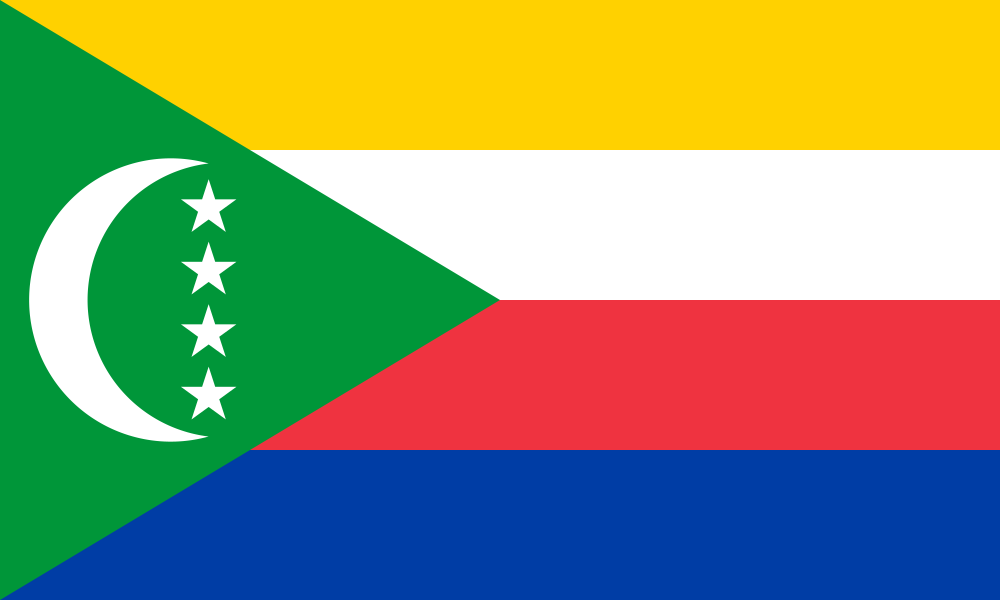 Comoros
Find best meeting timeMoroni is already loaded in the meeting planner.
12hr|24hr

08:53:22pm
Wednesday, October 7, 2026
Moroni • Indian/Comoro
Location
Interactive map loads after hydration. Capital coordinates: -11.70°N, 43.26°E.
Compare Times Live
The interactive time comparison grid loads in the live app. After the page hydrates you can add cities, drag rows, and share custom meeting windows.
ISLANDS OF SPICESUNIQUE SWAHILI CULTUREVOLCANIC ORIGINSMORNING COFFEE CEREMONYANCIENT SULTANATESTRADITIONAL KAWALU DANCECOMORIAN BAZAAR TRADITIONSUNESCO WORLD HERITAGE SITERICH MARITIME HISTORYLARGEST YLANG-YLANG PRODUCERCOMORIAN LANGUAGE DIVERSITYISLAND HOPPING ADVENTURESVIBRANT TEXTILE ARTISTRYNATURAL HONEY EXPORTSSALT-WATER CROCODILES NATIVEISLANDS OF SPICESUNIQUE SWAHILI CULTUREVOLCANIC ORIGINSMORNING COFFEE CEREMONYANCIENT SULTANATESTRADITIONAL KAWALU DANCECOMORIAN BAZAAR TRADITIONSUNESCO WORLD HERITAGE SITERICH MARITIME HISTORYLARGEST YLANG-YLANG PRODUCERCOMORIAN LANGUAGE DIVERSITYISLAND HOPPING ADVENTURESVIBRANT TEXTILE ARTISTRYNATURAL HONEY EXPORTSSALT-WATER CROCODILES NATIVEISLANDS OF SPICESUNIQUE SWAHILI CULTUREVOLCANIC ORIGINSMORNING COFFEE CEREMONYANCIENT SULTANATESTRADITIONAL KAWALU DANCECOMORIAN BAZAAR TRADITIONSUNESCO WORLD HERITAGE SITERICH MARITIME HISTORYLARGEST YLANG-YLANG PRODUCERCOMORIAN LANGUAGE DIVERSITYISLAND HOPPING ADVENTURESVIBRANT TEXTILE ARTISTRYNATURAL HONEY EXPORTSSALT-WATER CROCODILES NATIVE
Country Information
Capital
MoroniPopulation
74,749
Area
1,862 km²
Largest City
MoroniDaylight Saving Time (DST)
Not Observed
ISO Code
KM / COM
Time Zones
1 zone
Languages
Arabic, French, Comorian
Currency
Comorian Franc (Fr) - Fr100
Coordinates
Decimal:-11.7022, 43.2551
DMS:11°42′08″S, 43°15′18″E
Elevation
Highest:2,361 m
Lowest:0 m
Average:1,181 m
International Dialing Code
+269
Time Zones
• Indian/Comoro| EAT (UTC+3)
About Comoros
•The Comoros is an archipelago located in the Indian Ocean, situated between Madagascar and the African coast.
•The country consists of three main islands: Grande Comore, Mohéli, and Anjouan, along with several smaller islands.
•Comoros has a rich history influenced by African, Arab, and French cultures, evident in its diverse traditions and customs.
•The islands were inhabited as early as the 6th century by Bantu peoples, followed by Arab traders who settled in the region.
•Comoros gained independence from France in 1975, after a series of short-lived governments and political turmoil.
•The Comorian flag features four stars representing the main islands and a crescent moon, symbolizing Islam, which is the predominant religion.
•Shikomori, a blend of Arabic and Bantu languages, is widely spoken in Comoros, alongside French and Arabic.
•A significant cultural practice in Comoros is the celebration of weddings, which can last several days and involve traditional music and dance.
•The islands are known for their unique biodiversity, including endemic species of flora and fauna found nowhere else in the world.
•Comoros is renowned for its production of ylang-ylang, a key ingredient in perfumes, which contributes to its economy.
•The country's landscape is characterized by volcanic mountains, beautiful beaches, and lush vegetation, offering stunning natural scenery.
•Traditional crafts, such as weaving and pottery, play an important role in Comorian culture and are often passed down through generations.
•Comoros has faced various challenges, including political instability and economic difficulties, but continues to strive for development and growth.
•The island of Mohéli is home to the Mohéli Marine Park, which protects the rich marine biodiversity and serves as a sanctuary for sea turtles.
Cities in Comoros
Showing 3 cities (top 50 by population + business hubs). Click any city to view detailed time information.
Cities by Population
Popular Cities in Comoros
Related Pages
findtime.io
Popular Cities
v4.5-434-gde03e3eee-5803-de03e3e
